‘CSTO–SCO: A Security Space’: The future and potential of a unified security space discussed on sidelines of Eastern Economic Forum
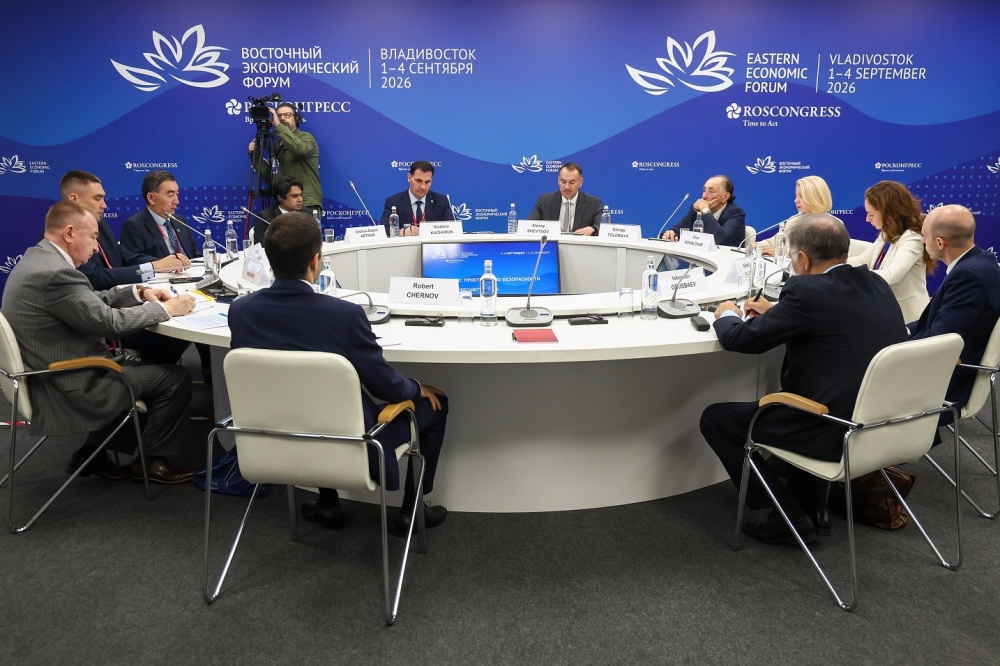
Key aspects of strengthening stability in the context of geopolitical challenges and ensuring security in Eurasia were at the top of the agenda of the ‘CSTO–SCO: A Security Space’ session held at the Eastern Economic Forum on 4 September.
The discussion focused on the potential of regional collective security mechanisms. Participants noted that the pooling of efforts by states within the CSTO and the SCO plays a decisive role in establishing a stable security environment and coordinating law enforcement and defence structures in the context of global turbulence.
“The primary development in the Eurasian geopolitical space is the shift of the countries of the collective West towards open confrontation with Russia. This brings to the fore the issue of building a renewed security architecture to help prevent conflicts and neutralize existing threats. The CSTO and SCO are key elements of this architecture. As for universal mechanisms, they are for the most part no longer effective: the influence of the UN Security Council is, lamentably, limited, with Western countries attempting to dilute its mandate, limit veto power, and inject their own neocolonial priorities into the agenda. The situation at the regional level is also far from ideal: the Council of Europe and OSCE have long since discredited themselves as instruments for ensuring security,” noted Deputy Secretary of the Security Council of the Russian Federation Alexey Shevtsov.
The discussion participants also broached the subject of countering modern cross-border threats – terrorism, extremism, and drug trafficking – as well as combatting information attacks.
In addition, special attention was paid to the role of the SCO in ensuring collective security in Eurasia.
“Security cannot be viewed solely through a military-political lens. Economic stability, reliable transport corridors, and the development of cross-border cooperation – all these are elements of a unified security space. The SCO demonstrates significant potential here, gradually shaping a comprehensive model of cooperation in which security issues are addressed in the context of the economy, transport, energy, the environment, healthcare, and humanitarian ties,” Adviser to the Secretary-General of the SCO Kazybek Kochkonov said.
Russia’s priorities for its CSTO chairmanship year were also highlighted during the session.
“The Russian chairmanship is being held under the motto ‘Collective Security in a Multipolar World: Common Goal, Shared Responsibility’. Our priorities are strengthening friendly ties among CSTO member states and building the organization’s potential, with the aim of giving fresh impetus to the development of the CSTO as it approaches its 25th anniversary. One of our key tasks is to boost the international standing of the CSTO and develop its practical ties with other structures in the Eurasian region. We want to further expand cooperation between friendly countries and international organizations, including by leveraging observer and partner status. In our opinion, the CSTO and SCO should lead the process of shaping an architecture of equal and indivisible security across the Eurasian space, given that their activities are grounded in a philosophy of constructive engagement and the very principles that should form the basis of this new architecture: respect for independence and sovereignty; voluntary participation; equality of rights and obligations among member states; and non-interference in matters of national jurisdiction. This is the kind of pan-continental security mechanism that is exactly what we need,” noted Deputy Director of the First CIS Department of the Ministry of Foreign Affairs of the Russian Federation Irina Kovalchuk.
Other participants in the session included Head of the International Activities Department of the Federal Service for Surveillance on Consumer Rights Protection and Human Wellbeing Nikolai Balan, Head of the Center for Central Asian Studies of the Institute of China and Contemporary Asia of the Russian Academy of Sciences Alexandra Perminova, Executive Secretary of the CSTO Parliamentary Assembly and Head of the Secretariat of the CSTO Parliamentary Assembly Sergey Pospelov, and representatives of the CSTO Secretariat and Joint Staff.
Issues regarding the further development of the CSTO will be examined in greater detail at the upcoming International Collective Security Forum, which will take place in Moscow on 10–11 November as part of Russia’s chairmanship of the CSTO this year.
The event has been organized by the Ministry of Foreign Affairs of the Russian Federation and the Roscongress Foundation, with the support of the Government of the Russian Federation.
The Eastern Economic Forum took place on 1–4 September at the Far Eastern Federal University campus in Vladivostok. The theme of this year’s Forum was ‘The Far East: Development for the Benefit of People’. It was organized by the Roscongress Foundation.