Eastern Economic Forum highlights historical and geopolitical aspects of transport integration
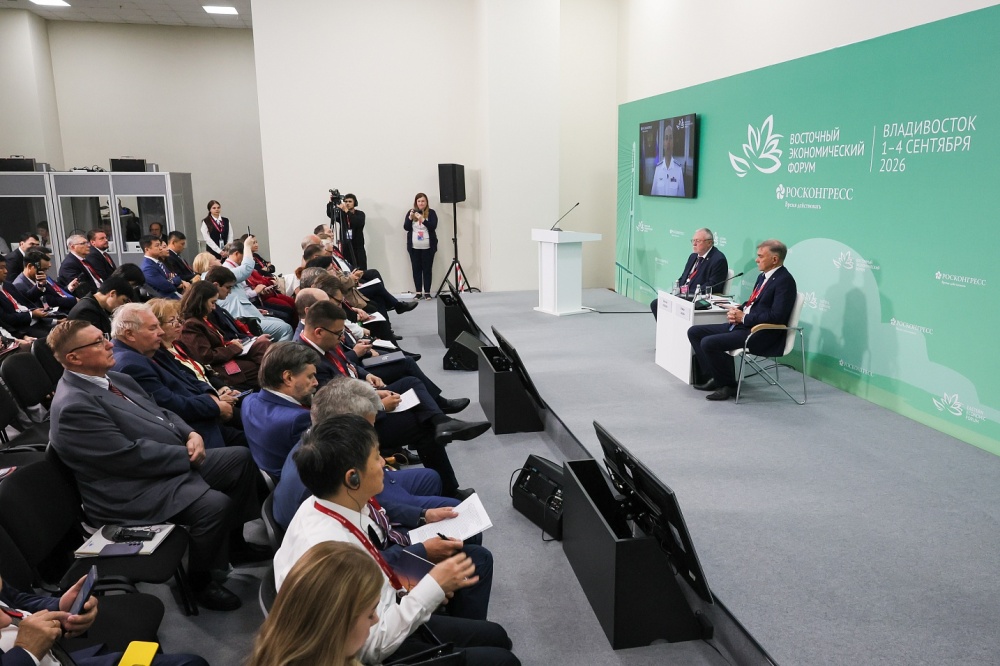
On 1 September Vladivostok hosted the plenary session of the international conference ‘Crossroads of Civilizations: The Role of Transport Integration in the History of the Asia-Pacific Region’ as part of the Eastern Economic Forum. Attendees explored how evolving trade routes, railways, shipping links, and other transport networks have defined the Far East, driven international relations, and fuelled regional economic growth.
Organized by the Russian Historical Society, the event brought together scholars and experts from nine Asia-Pacific nations.
Ahead of the plenary session, Sergei Naryshkin, Chairman of the Russian Historical Society (RHS), welcomed the participants, emphasizing that transport corridors have for centuries served as vital arteries not just for cargo, but for sharing knowledge and technology across the region.
“Just like in the rest of the world, trade routes in the Asia-Pacific region have long connected societies, acting as pipelines for goods, knowledge, and technology. Looking back at their history makes us think not just about past economies, but about the military, political, and cultural forces that shaped them,” emphasized Sergei Naryshkin.
The RHS Chairman also highlighted the role of the Trans-Siberian and Ulaanbaatar Railways in the history of Russia and its partnerships across Asia. Additionally, he noted that the conference succeeded in drawing representatives from nine countries of the region.
Konstantin Mogilevsky, Deputy Minister of Science and Higher Education of the Russian Federation and Co-Chair of the Russian Historical Society, also addressed the attendees. In his remarks, he tied the history of Russia’s transport networks in the Asia-Pacific region directly to the growth of the Russian Far East.
"For Russia, the history of transport corridors in the Asia-Pacific region is deeply intertwined with the development of our Far East. Ever since Okhotsk was founded as Russia’s first Pacific port, Russia has steadily expanded its footprint in these territories, including by building up their transport infrastructure,” Konstantin Mogilevsky noted.
He then shifted focus to the importance of training future professionals for the modern transport sector.
“We have to remember that transport isn’t just about airports, train stations, and harbours. Ultimately, it’s about people, especially engineers,” he concluded.
Today, over 125,000 students are training to become transport specialists across 22 Russian universities. Their curricula go beyond the basics to include cutting-edge fields like artificial intelligence, digital modelling, and unmanned aerial systems.
Shifting the focus to a historical perspective, Ruslan Gagkuev, Chairman of the Board of the Russian Historical Society, highlighted the role of transport corridors during times of crisis.
“The strategic value of transport networks is evolving alongside shifting political and economic realities. In times of peace, railways, shipping lanes, and other transport links are indispensable for bridging different regions, driving the economy and trade, fostering cultural exchange, and establishing humanitarian contacts. But during critical turning points – especially amidst political upheaval and armed conflict – these networks take on an entirely different weight. They cease to be just routes and become vital infrastructure that can determine troop resupply, command stability, and the overall capabilities of each side in the conflict,” Ruslan Gagkuev stated.
He pointed to the Chinese Eastern Railway as a prime example, noting how it transformed into a fierce battleground for military and political dominance among all warring factions during Russia’s Civil War.
Centred on the deep historical and geopolitical dimensions of transport integration, the opening half of the plenary session featured insights from Irina Popova, Director of the Institute of Oriental Manuscripts of the Russian Academy of Sciences; Denis Tsypkin, General Director of the National Library of Russia and Russian Historical Society Council member; Yuri Nosov, Director General of the Boris Yeltsin Presidential Library and Russian Historical Society Council member; and Le Bo Lin, President of the Institute for the Study of Economic Strategies.
The conference was jointly organized by the Russian Historical Society, the Ministry of Transport of the Russian Federation, and Far Eastern Federal University, alongside the Institute of History, Archaeology, and Ethnography of the Peoples of the Far East and the Institute of Oriental Studies, both under the Russian Academy of Sciences. The event received backing from the History of the Fatherland Foundation as part of the ‘Youth and Children’ national project.
The 11th Eastern Economic Forum (EEF) is taking place from 1 to 4 September at the Far Eastern Federal University campus. The Forum’s main theme is ‘The Far East: Development for the Benefit of People’. EEF is organized by the Roscongress Foundation and supported by the Government of the Russian Federation.