Russia ready to be active part of SCO integration projects to achieve sustainable development goals
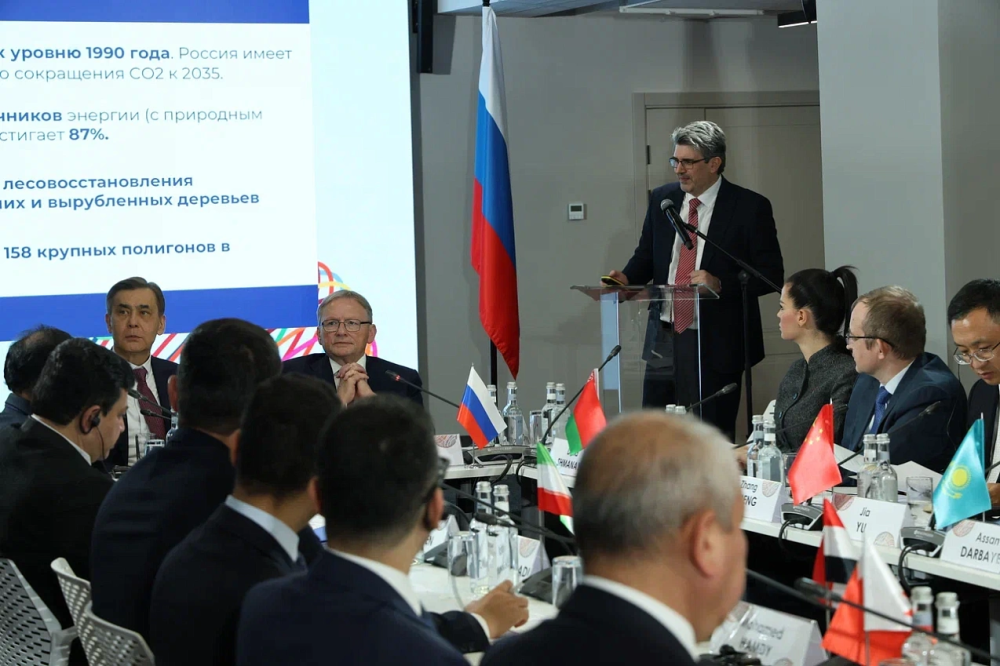
The announcement was made by Executive Director of the Stolypin Institute for the Economy of Growth Anton Sviridenko during the SCO Sustainable Development Forum in Moscow.
“The institutional basis for this has already been laid,” Sviridenko noted, “since the SCO Development Strategy until 2035 includes a plan to create an SCO Investment Fund, accompanies by an increase in settlements in national currencies. The SCO Interbank Consortium is moving along nicely. Potential areas for joint activities include such promising spheres as the development of energy sources, joint space projects, agriculture, pharmaceuticals, technology transfer, exports services, cooperation in nuclear energy, etc. Moreover, specific joint SCO development projects are key to our own economic and social success, ensuring that we don’t need to wait for funds from the West or international organizations.”
“Examples of integration already exist. For example, China has launched several projects in the SCO space as part of its One Belt, One Road programme and Global Development Initiative; Russia is offering its tax super-services to developing countries; and India is developing infrastructure cooperation with the countries of Central Asia.”
“Russia has successfully integrated the Sustainable Development Goals into its own National Development Goals: according to the UN, our country is making progress on 142 of the 231 SDG indicators,” the Executive Director of the Institute for the Economy of Growth pointed out. “We have a large margin when it comes to meeting the conditions for reducing carbon dioxide emissions by 2035; the share of low-carbon energy sources (including natural gas and nuclear energy) is already at 87%. For the fourth straight year, the total area of reforestation in Russia has exceeded the total area of dead and felled trees. And 158 massive landfills inside city boundaries have been eliminated over the past six years.”
“More than 115 best corporate practices of Russian companies were presented at the United Nations this year, and a collection of technological solutions for sustainable development was also compiled. Russia’s ESG path is evident in the implementation of the Business Social Capital Standard (BSCS), which will become a unified measure of business success in terms of its sustainability and social responsibility. And the BSCS methodology deserves to be used as a basis for the entire SCO, or at least studied so we can develop a unified assessment methodology.”
The event was organized by the Special Representative of the President of the Russian Federation for Relations with International Organizations to Achieve Sustainable Development Goals Boris Titov and the SCO Secretariat, with the support of the Ministry of Economic Development of the Russian Federation, and operated by the Roscongress Foundation.
The main objective of the Forum is to discuss the current state of the UN Sustainable Development Goals (SDGs) programme around the world, and in the SCO countries in particular; the revised edition of the SDGs until 2030; the SCO’s participation in building a new global development architecture; best ESG practices in the SCO space; and the prospects for joint projects and programmes on sustainable development.