Russian-Thai Investment Forum: New Opportunities for Bilateral Relations
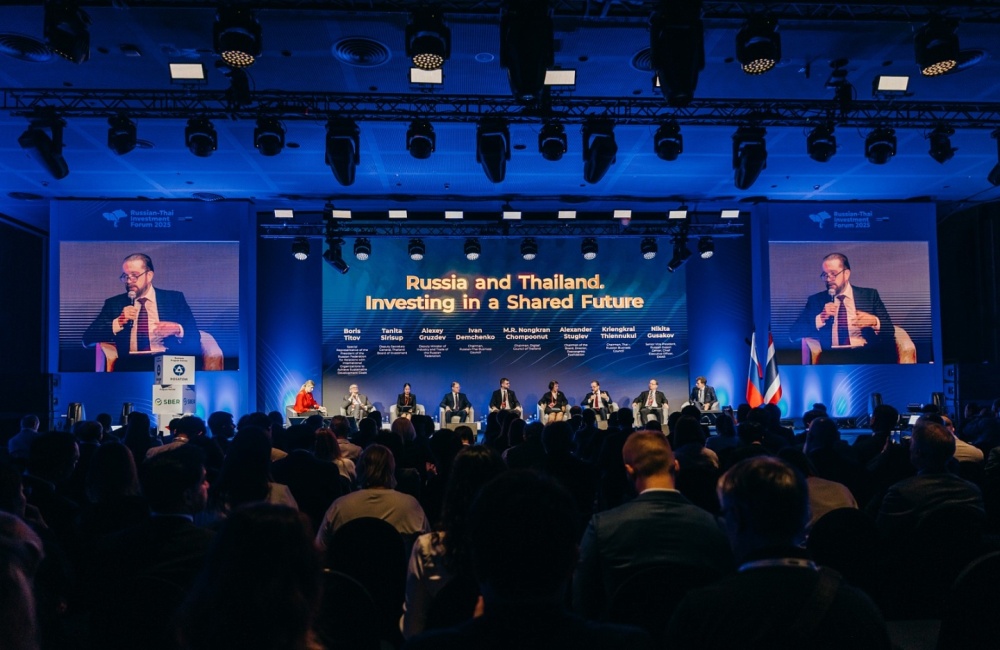
The first ever Russian-Thai Investment Forum brought businesspeople, investors, and government officials from Russia, Thailand, and other countries to Phuket on 26–28 November 2025. Over a three-day period, the Forum was attended by more than 1,100 visitors from Russia, Thailand, China, and all across Southeast Asia, Europe, and the Middle East.
The Forum was organized by the Russian-Thai Business Council (Association for the Development of Entrepreneurship and Support of Business Relations with Thailand) in conjunction with the Embassy of the Kingdom of Thailand in Russia, the Embassy of the Russian Federation in Thailand, and the Ministry of Industry and Trade of the Russian Federation. The business programme partners were Rosatom and Sberbank. The strategic partner was Made in Russia. The media partners were Forbes and Russkoye Radio. The organizational partners were the Roscongress Foundation, the Chamber of Commerce and Industry of the Russian Federation, and Delovaya Rossiya. The official transport company of the Forum in Phuket was Etagi.
Important topics covered during the Forum included development, digitalization, logistics, tourism, construction, medicine, and the creative economy, all popular among pre-forum survey respondents.
The highlight of the Forum was the plenary session ‘Russia and Thailand. Investing in a Common Future’, as part of which business leaders and officials discussed bilateral cooperation against a backdrop of growing trade. Minister of Foreign Affairs of the Russian Federation Sergey Lavrov addressed Forum participants and spoke of bilateral relations based on long-standing, mutually beneficial cooperation.
According to statistics for 2025, trade between Russia and Thailand continued to grow, rising to USD 328.9 million in January–February 2025, an increase of 10.6% over the same period in 2024. Russian exports reached USD 139.7 million (+7.7%), with imports from Thailand at USD 189.2 million.
Chairman of the Russian-Thai Business Council and CEO of Novostal-M Ivan Demchenko spoke of the growth in cooperation between the countries.
“Russia cannot be cut off from the global economy. Thailand has not imposed sanctions and remains Russia’s most reliable partner in the region. We see opportunities in construction, trade, and the creation of joint business infrastructure, such as banks, investment platforms, and logistics routes. Leasing, especially aircraft leasing, is particularly promising,’ Ivan Demchenko said.
Thailand is actively developing as an industrial hub for automotive, electronics, chemicals, and logistics, all making it an attractive destination for investors. The great potential in the country for foreign factories, industrial facilities, logistics sites, and IT infrastructure also came up during the Forum.
“Thailand is one of the most important, fastest developing economies in Southeast Asia. As the growth of digital infrastructure in the country picks up pace, so does the construction of modern data centers. Rosatom is ready to provide a reliable source of energy through large nuclear power plants and small land-based and floating modular reactors,” Rosatom Regional Director for Business Development in Thailand, Laos and Myanmar Ilya Bychkov said.
Additional incentive for investment is provided by the Board of Investment of Thailand (BOI), which gives investors the opportunity to purchase land in the event a project is approved, greatly simplifying the steps needed to start local production. As a result, investors from Russia and other countries have already begun to consider projects in this sector, as well as IT, biotechnology, logistics, and development.
One Russian company already in Thailand is the Biomicrogels Group, which has leased a factory in Laem Chabang Port, where it intends to produce biopolymer-based reagents for water purification. Production is expected to get underway in April 2025. Another is Amarant Agro, which is considering leasing a site to produce snacks, oil, feed, and bioactive supplements in Thailand.
Experts have noted an increase in Russian businesses preparing to enter the market with well-developed legal structures, financial models, and strategies tailored to Thai regulations and the local business culture. Such companies are expected to build sustainable businesses to compete in the Asian market, and an exhibition space at the Forum dedicated to the best business practices from Russia and Thailand brought together Russia and Thailand’s largest development and investment companies. Forum participants also had access to Russian Export Center Made in Russia, Roscongress International, and Innovation Space B2B zones.
“The Russian Export Center has created the Made in Russia programme to promote Russian products, and we see significant potential for cooperation to increase across a wide range of industries. We can already observe a significant increase in exports of agricultural and fast-moving consumer goods to Thailand. Another promising area of mutual interest is high technology, particularly smart cities. At the same time, traditional industries are growing too. The tourism boom, for example, has led to an increase in demand for Russian construction materials. And Russians are already investing in Thailand and acquiring real estate, though for sustainable development, we need to shift the focus to investment in manufacturing,” Senior Vice President of the Russian Export Center Nikita Gusakov said during the plenary session ‘Russia and Thailand. Investing in a Shared Future’.
A common theme during the official speeches delivered at the Forum was a commitment to further developing the existing partnership. The need for Russian and Thai banks to create joint financial, logistics, and business platforms to simplify payments and reduce dependence on restrictions was also noted.
“The potential for cooperation between Russia and Thailand extends far beyond traditional sectors. Education and the creative industries are particularly important, and a number of agreements were signed this year between universities and organizations working in the creative industries in the two countries. Long-term cooperation and understanding finds a strong foundation in these areas. Medicine, logistics, energy, construction, real estate, and innovation also hold a lot of promise,” Chairman of the Board and CEO of the Roscongress Foundation Alexander Stuglev said.
As part of the business programme, the Russian-Thai Business Council signed key memoranda of cooperation with the Thai-Russian Business Council and the Digital Council of Thailand. More meetings, negotiations, and detailed project development have been planned to continue in the wake of the Forum. In the end, RTIF 2025 in Phuket has proven more than a simple platform for dialogue, growing into a starting point for the implementation of real projects.
Russian companies choosing to take advantage of BOI incentives, well-developed infrastructure, and Thailand’s favourable geographic location will find cooperation reaching fundamentally new heights and resulting in sustainable export growth, more joint ventures, and a stronger Russian economic presence in Southeast Asia.
“We had originally assessed the investment potential of joint projects at approximately one billion dollars. This Forum, however, has shown the actual scale to be significantly higher, roughly three billion dollars. We also expect trade to grow next year, and though we can’t say yet by exactly how much, the increase we are hoping for is significant,” Ivan Demchenko said in conclusion.